Les Pronoms relatifs en anglais
Tout savoir sur les pronoms relatifs !

Il n’existe que quelques pronoms relatifs en anglais. Les plus courants sont who, whom, which, that, whose. Les pronoms relatifs sont des conjonctions qui relient une proposition à une autre.
Définition d’un pronom relatif :
Un pronom relatif est un mot utilisé pour faire référence aux noms mentionnés précédemment, qu’il s’agisse de personnes, de lieux, de choses, d’animaux ou d’idées. Les pronoms relatifs peuvent être utilisés pour relier deux phrases.
Les pronoms relatifs en anglais sont des conjonctions qui relient des propositions (clauses) aux autres. Ils donne des informations supplémentaires ou essentielles sur un nom dans une phrase.
par exemple :
- The girl who lives next door is my friend. (Cette proposition donne une information importante)
- Sarah, who lives next door, is my friend. (Cette proposition donne une information secondaire.)
Tout savoir sur les pronoms relatifs !
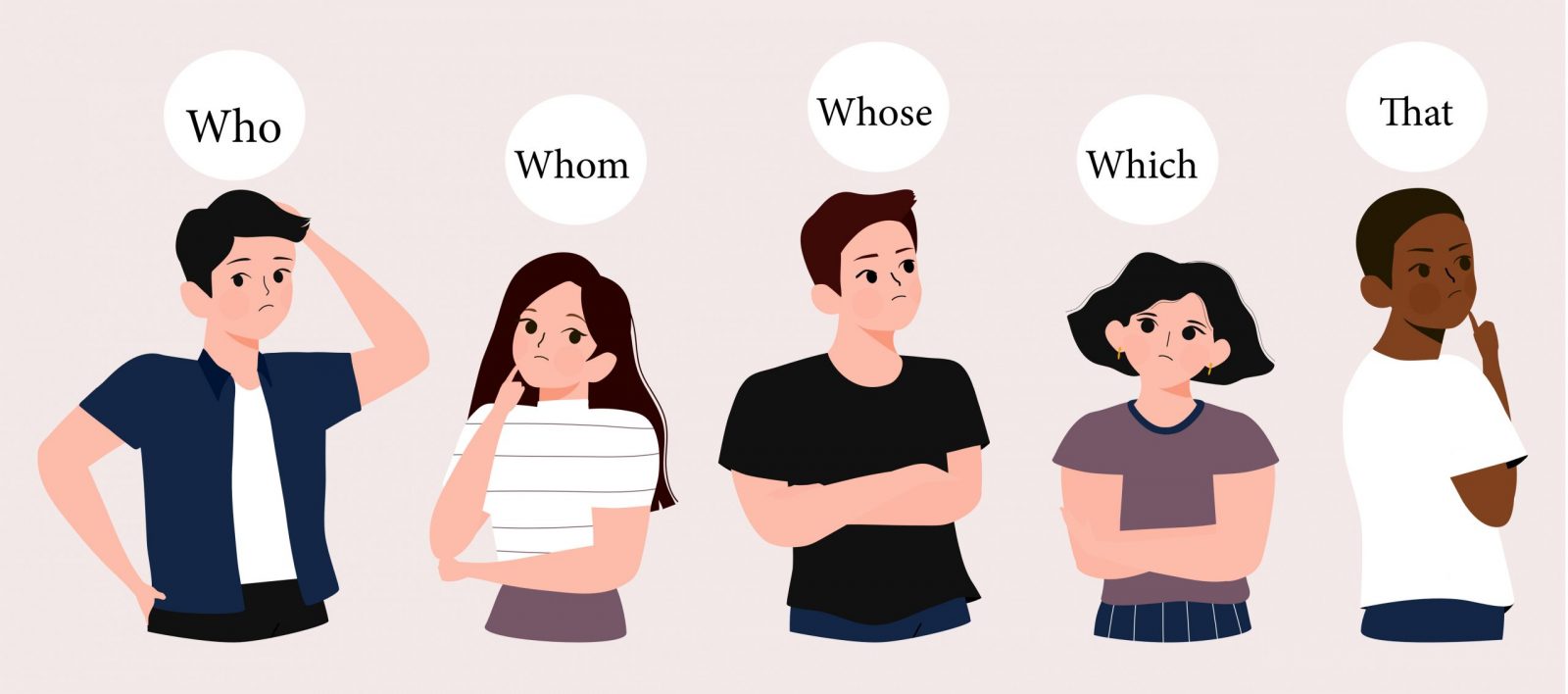
- Who : utilisé pour désigner le sujet d’une phrase → who + verbe (Who called you? – Qui t’a appelé ?)
- Whom : employé pour désigner le complément d’objet direct (COD) → whom + sujet + verbe (Whom did you see? – Qui as-tu vu ?)
- Whose : marque la possession et précède un nom → whose + nom + sujet + verbe (Whose book is this? – À qui est ce livre ?)
- Which : utilisé pour parler d’objets ou d’animaux. Il peut être sujet (which + verbe) ou complément d’objet (which + sujet + verbe) (Which car do you prefer? – Quelle voiture préfères-tu ?)
- That : pronom neutre pouvant remplacer une personne ou un objet. Il peut être sujet (that + verbe) ou complément d’objet (that + sujet + verbe) (The book that I borrowed was amazing. – Le livre que j’ai emprunté était génial.)
Who est un pronom relatif équivalent à “qui” en français. Il joue le rôle de sujet dans une proposition relative et est suivi d’un verbe. Ce pronom est exclusivement utilisé pour faire référence à une personne.
➡ Exemple : The mechanic who fixed our car lives in the garage. (Le mécanicien qui a réparé notre voiture vit dans le garage.)
Whom est un pronom relatif équivalent à “que” en français. Il fonctionne comme complément d’objet direct (COD) dans une proposition relative et est suivi d’un sujet et d’un verbe. Ce pronom est uniquement utilisé pour faire référence à une personne.
➡ Exemple : The man whom you met at the party is my uncle. (L’homme que tu as rencontré à la soirée est mon oncle.)
Le pronom relatif “which” est utilisé pour remplacer tout sauf les personnes. Il peut être équivalent à “qui” lorsqu’il est sujet de la proposition relative et à “que” lorsqu’il est complément d’objet direct (COD).
➡ Sujet : The car which is parked outside is mine. (La voiture qui est garée dehors est la mienne.)
➡ COD : The car which you bought is nice. (La voiture que tu as achetée est belle.)
Le pronom relatif “that” est neutre et polyvalent. Il peut remplacer une personne, un objet, un animal, etc., ce qui le rend très pratique. Si vous hésitez entre plusieurs pronoms relatifs, “that” est souvent un choix sûr.
➡ Sujet :
- The person who/that lives next door is our doctor. (That remplace “who” en tant que sujet.)
- The car which/that is parked outside is mine. (That remplace “which” en tant que sujet.)
➡ Complément d’objet direct (COD) :
- The person whom/that you met at the party is my sister. (That remplace “whom” en tant que COD.)
- The car which/that you bought is nice. (That remplace “which” en tant que COD.)
Le pronom relatif “whose” exprime la possession et remplace un pronom possessif comme his, her, their, etc. Il est l’équivalent de “dont” en français et relie un nom à un autre pour indiquer une relation de possession.
➡ Exemple 1 : The woman whose purse was stolen called the police.
- The woman called the police.
- Her purse was stolen.
- The woman’s purse was stolen.
➡ Ici, “whose” relie “the woman” et “purse” pour montrer la possession.
➡ Exemple 2 : The man whose wife is the queen died at the age of 99.
- The man died at the age of 99.
- His wife is the queen.
- The man’s wife is the queen.
➡ “Whose” permet d’associer “the man” et “wife” en exprimant la possession.
Le pronom relatif “who” est utilisé comme sujet de la proposition relative et est suivi d’un verbe. Il permet de relier deux phrases en mettant en avant une personne.
➡ Exemple : The mechanic who fixed our car lives in the garage.
- The mechanic lives in a garage.
- The mechanic fixed our car. (The mechanic est sujet, donc on utilise “who”.)
Le pronom relatif “whom” est utilisé comme complément d’objet direct (COD) et est suivi d’un sujet et d’un verbe.
➡ Exemple : The man whom you met at the party is my uncle.
- The man is my uncle.
- You met the man at the party. (The man est COD, donc on utilise “whom”.)
En résumé, “who” est sujet et précède un verbe, tandis que “whom” est COD et précède un sujet + verbe.
En anglais, “who” et “whom” sont des pronoms relatifs utilisés pour remplacer des personnes : “who” est employé comme sujet, tandis que “whom” est utilisé comme complément d’objet direct (COD).
Le pronom relatif “which”, quant à lui, est utilisé pour remplacer tout sauf des personnes, c’est-à-dire des objets, des animaux ou des idées.